Sometimes the ideas of (co)limits and subcategories don’t really play nicely with each other. A (co)limit of a diagram in a category has two basic pieces. One is an object of the category which people usually think of as being the “result” of taking the (co)limit. The other is a (co)cone, which is a bunch of maps between the objects of diagram and the (co)limit object such that everything commutes. So a subcategory has two different ways it can screw up a particular (co)limit (assuming the whole diagram is in the subcategory): by not having the (co)limit object, or by not having all the maps in the (co)limiting (co)cone. If C’ is a subcategory of C, and D is a diagram in C’ such that the (co)limit of D exists in C, call it X, and the (co)limit of D exists in C’, call it Y (they don’t have to be the same), then the universal property gives a unique morphism of C between X and Y (X to Y for limits, Y to X for colimits) making everything commute. I’ll describe a few specific examples that I’ve used.
Bijections
First, an example of how the arrows can get messed up. Consider the category FinSet with finite sets for objects and functions for morphisms. It has all coproducts (colimit of any pair-of-objects diagram) given by disjoint union and inclusion maps.

Now consider the wide subcategory FB 
- John Baez, John Foley, Joseph Moeller, and Blake Pollard, Network Models
Monoids
Now, an example of the object not being present. Consider the category Mon of monoids and monoid homomorphisms, and the full subcategory CMon of commutative monoids. Mon has coproducts, given by the “free product”. If M and N are monoids, then their free product M*N has elements that are “words” of elements from M and N. If two “letters” come from the same monoid in a given word, you can multiply them as in that monoid, and the identity elements of both monoids are identifed with the “empty word”, which then acts as the identity element. Unless one of them is the trivial monoid, M*N is never commutative.
So the coproduct in Mon of two commutative monoids is not in CMon, however, this does not mean that CMon does not have coproducts! Coproducts in CMon are given by products! You can see why this should be true in two different ways. Algebraically, you take the free product M*N, and then mod out by the relation making everything commute. Then in a given word, you can rearrange so that all the letters from M are grouped together, and likewise for N. This is essentially the same as an ordered pair, i.e. an element of M


This example generalizes to any variety of monoids. A variety of monoids is a full subcategory of the category of monoids which contains all the monoids satisfying a set of defining relations. For example the category of commutative monoids is the variety of monoids which satisfy the relation ab = ba for all pairs of elements a,b. A graphic monoid is one where aba = ab for every pair of elements a,b. The subcategory of graphic monoids is another example of a variety. Notice that the trivial monoid is in every variety.
As with the variety of commutative monoids, the free product of two monoids in a variety is generally not in that variety. However, you can just mod out the free product by the defining relations of the variety. This gives the coproduct in the variety. I used this to generalize the notion of graph products of monoids, which I needed to describe free network models:
- Joseph Moeller, Noncommutative Network Models
Graphs
By “graph”, I mean a directed multigraph. The coproduct in the category of graphs is given by disjoint union. The coproduct in the category of graphs with the same set of vertices X is given by first taking the disjoint union, then identifying the vertices that correspond to the same element of X. Another way of looking at this is that you overlap the two graphs just right so that their vertices line up. This is also the pushout over the obvious inclusions of the graph with X vertices and no edges into the two graphs.
Indexed Categories
Let 


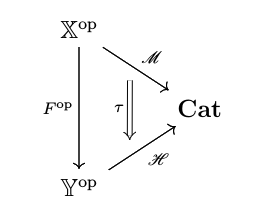
We call the category of indexed categories and indexed morphisms ICat. Given two indexed categories 

Consider the subcategory of ICat with only indexed categories of the same base 


where the first part is just duplication, and the rest is the same as before, i.e.
Fibrations
A fibration is a functor 


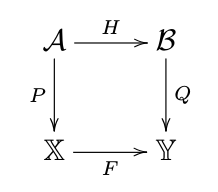
commutes, and H respects the lifting property of P and Q. We call the category of fibrations and fibred morphisms Fib.
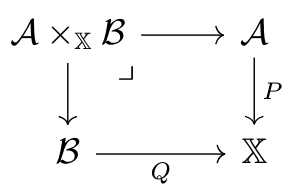
Given two fibrations 
Consider the subcategory of Fib with a fixed base category 

These last two examples, indexed categories and fibrations, are deeply connected through something called the Grothendieck construction. I plan to talk about this connection in a future blog post. In the following paper, we talk about monoidal variations of this construction.
- Joseph Moeller and Christina Vasilakopoulou, Monoidal Grothendieck Construction
It is also central in the construction of network operads in the other papers I mentioned.
 Joe Moeller
Nice!
LikeLike
Thanks! I wrote this a while ago, and just waited for the Monoidal Grothendieck paper to hit the arxiv to publish it.
LikeLike