Recall that in algebraic topology, we construct homotopy invariants, e.g. homology. Homology measures “global” topology, but its not very sensitive to local structure.
However, Poincare noticed that if X is a closed oriented manifold of real dimension n, then 
Poincare Duality: Let X be an orientable manifold of dimension n. Then there exists natural isomorphisms
where [X] is the fundamental class.
![[X] \cap - \colon H_K(X, \mathbb Z) \rightarrow H_c^{n-k} (X, \mathbb Z)](https://s0.wp.com/latex.php?latex=%5BX%5D+%5Ccap+-+%5Ccolon+H_K%28X%2C+%5Cmathbb+Z%29+%5Crightarrow+H_c%5E%7Bn-k%7D+%28X%2C+%5Cmathbb+Z%29&bg=060f29&fg=f2f2f2&s=0&c=20201002)
Theorem: Let X be a smooth complex affine variety of complex dimension n. Then X has homotopy type of a CW complex of real dimension n. In particular, 
Proof idea: Morse Theory
Definition: Let X be a manifold. A smooth function 
- for any real number s,
is compact,
- every critical point of f is non-degenerate
Recall, a point x in X is a critical point of f if 

Example: consider the “height” function on an upright torus,
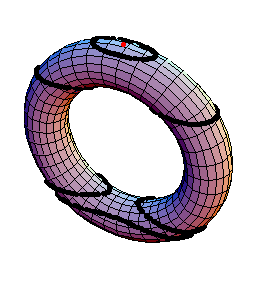
it has four critical points, depicted below
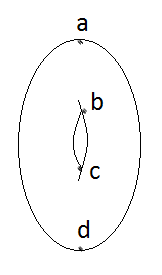
Note that d has index 0, c has index 1, b has index 1, and a has index 2.
Theorem: Let
So in the torus example, you think of building the CW complex by starting at the bottom, you start with a 0-cell. As you scan up, you have a disk, which is still homotopic to a point. Then when you reach c, you have to introduce a 1-cell, and it something like a basket with a handle. Then when you reach b, you have to add another 1-cell, and at a you add the 2-cell. This will give you a CW complex that looks like the standard way to build a torus by identifying sides of a square.
Lemma: Let 


proof: Note 


claim: q is immersive at (x,y) in Z iff the critical point x of
proof: q is immersive at (x,y) iff for any 


In local coordinates {x_i} on X near x,

Let 


which gives

Lemma: For 


proof: Let x be a critical point of 


If we could diagonalize 
 Joe Moeller
2 thoughts on “Algebraic Analysis notes Lecture 2 (9 Jan 2019)”