Theorem: If is a smooth affine complex algebraic variety of complex dimension n, then X has the homotopy type of a CW complex of real dimension n.
Note that this theorem is saying that certain spaces of real dimension 2n are homotopic to spaces with half the dimension.
Last time we showed that for generic y in , given by is Morse! In particular, it has non-degenerate critical points. So X has the homotopy type of a CW complex with one cell for each critical point x of which will have dimension equal to the index of the critical point. We want to show that at any critical point, the index is at most n. We computed for
Let .
claim: Q is the real part of a complex bilinear form H on .
Assume for a moment that this claim is true. Consider the map given by multiplication by i on , . This is unitary with respect to the standard Hermitian form . So , and then . If is an orthonormal eigenbasis with eigenvalues , then is also an orthonormal eigenbasis, but now with eigenvalues . So Q has eigenvalues in pairs , so Hess_x has eigenvalues . At most one of these is negative, so Hess_x has at most n negative eigenvalues. So the index of x is less than or equal to n, as desired.
Sketch of proof for the claim:
where is given by , where .
Now, can be recognized as the derivative of a complex algebraic map. Let (where is the Grassmannian of n-planes in N-space) given by . Then . Which gives a map (via currying, if you saw Jade’s tweet) . Since is linear, then is bilinear, as is linear in the second entry.
This proves the theorem, which is the starting point for a lot of cool stuff.
Lefschetz Hyperplane Theorem: Let be a complex projective (possibly singular) variety, and be a hyperplane. Let . Assume that X\Y is smooth. Then for k≤n-1. In particular, induces the map , which is an isomorphism for k<n-1, and injective for k=n-1.
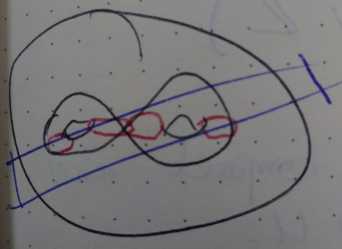
from my notes, sorry I’m not an artist
In the picture, the black circle is the ambient projective space, the black torusy thing is the variety X, the blue rectangle is the hyperplane, and the red bits are the intersection Y.
proof: Let U=X\Y. Note, if you remove a hyperplane from projective space, you gen an affine space, so U is a smooth affine variety! Choose a fundamental system of neighborhoods of Y such that deformation retracts onto Y for any i. Note that is compact and is a deformation retract of an open set in U. Then




 Joe Moeller
2 thoughts on “Algebraic Analysis notes Lecture 3 (11 Jan 2019)”