Last time: Hard Lefschetz gives an orthogonal decomposition 

On the other hand, Hodge theory gives a decomposition 


Hodge-Riemann bilinear relations: The form 

Products: Fundamental group (or higher homotopy groups) we have 
Kunneth Formula: for k a field, 
Locally products: A fibre bundle consists of a total space E, a base space B, a fibre F, and a map 
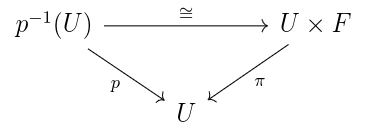
Question: what is the relationship between 


Example: 


Then we can draw 
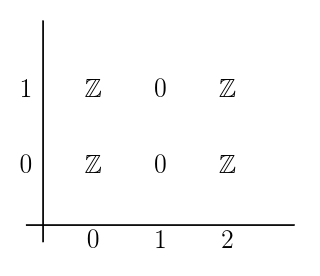
If we take sums along diagonals, i.e. 


Answer [Leray-Serre]: If B is simply-connected, then there is a spectral sequence 
Roughly, 

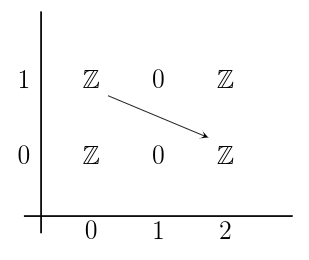
Theorem [Deligne-Blanchard]: Let 

So 
The theory of intersection cohomology and perverse sheaves gives a way to simultaneously generalize all of this! Poincare duality, weak & hard Lefschetz, and Hodge-Riemann bilinear relations, intersection cohomology will tell us that some modification of these theorems hold for any projective algebraic variety (not necessarily smooth), and a vast generalization of Deligne’s theorem to arbitrary proper algebraic maps 
To do this we’ll need the theory of sheaves and homological algebra and category theory!
Presheaves
Let X be a topological space. Let Op(X) denote the category with open sets of X for objects and inclusions for morphisms. For a ring k, a presheaf of k-modules on X is a functor 

Let’s unpack this definition. F is a rule which assigns to each open subset U of X a k-module F(U), and to each inclusion 


A morphism 
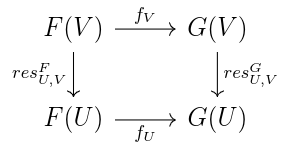
If s is an element of F(V), and U is a subset of V, sometimes we write 
Example: Let M be a k-module. The constant presheaf on X with value M, denoted 


We’ll have to continue with sheaves next time.
 Joe Moeller
2 thoughts on “Algebraic Analysis notes Lecture 5 (16 Jan 2019)”