Lecture 2 here. Thanks again to Tim Hosgood for the beautiful pictures.
The category of species
Last time, we looked at the relationship between species and their generating functions, a formal power series associated to a species which lets you count structures described by the species. Now we’ll take a closer look at species themselves. In particular, there is a category where the objects are species. As is the case in so many branches of math, looking at the category of our main objects of study will be a useful perspective.
There is a category of species, called 


There is a subcategory of 
We’ve talked about functors in this class before, but not yet natural transformations. Recall: given categories 


If 


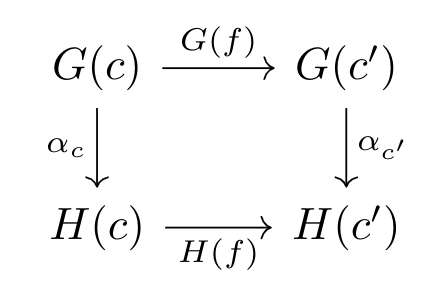
commutes. If all the components 

Proposition: If 

Theorem: If 


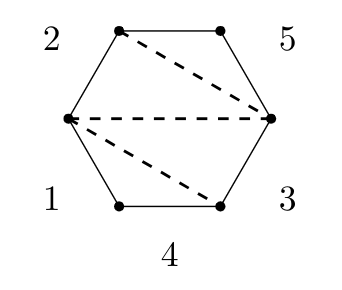
Example: Let 
- draw a regular (|X|+1)-gon;
- label all but one of the sides with the elements of X;
- triangulate the polygon.
For example, here is an element of P(5):
Example: Let 
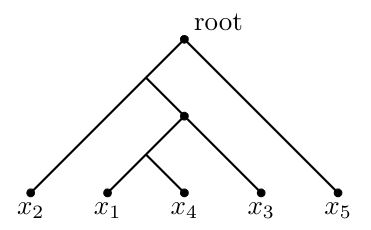
Theorem: 
Proof idea: We need bijections 

Given the tree in 

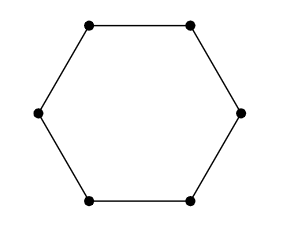
Rather than labelling sides, we’re going to label vertices that we place just outside of each side of the polygon (except for one that we place inside). So we draw 
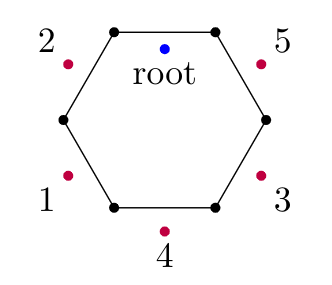
Then we draw a copy of our tree inside the polygon.

Finally, we triangulate our polygon by crossing each branch of the tree exactly once.
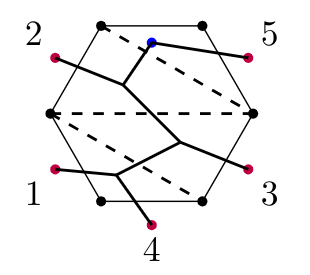
Theorem: Let 


Note that the converse is not true! In future lectures, we’ll look at examples of non-isomorphic species with the same generating functions.
Proof: If there’s a natural isomorphism 


In Lecture 4, we’ll begin to see how we can actually use species and their generating functions to solve problems in combinatorics.
 Joe Moeller
2 thoughts on “Combinatorics, Lecture 3 (3 Oct 2019)”