Using Generating Functions
We defined two binary operations on species 
Addition. 
Multiplication. 
These obey 


and

we see that

which is some poorly-understood operation on power series.
Recall that 


Let 
For example
TO(3) = {[0 < 1 < 2], [0 < 2 < 1], [1 < 0 < 2], [1 < 2 < 0], [2 < 0 < 1], [2 < 1 < 0]}
so |TO(3)| = 6.
Note 
To put a TO structure on X you can pick one element of X to be the least element, and then put a TO structure on 


and so, rearranging, we get that


and so |TO(n)|=n!.
Notice that we used both subtraction and division, which are not really things that we can do with finite sets. The result, however, is obvious, since to totally order an n-element set we choose one element to be the least (n choices), then one to be the next least (n-1 choices), etc., so n(n-1)(n-2)…1=n! choices in total.
Fibonacci numbers
Let’s start with a sequence of numbers, turn it into a generating function, and then find a species with that generating function! All mathematicians are in love with the Fibonacci numbers, which are defined recursively by 

Let’s invent a power series coming from this sequence:

(note that there’s no n! here).
Now let’s turn the recursive definition into some fact about f.
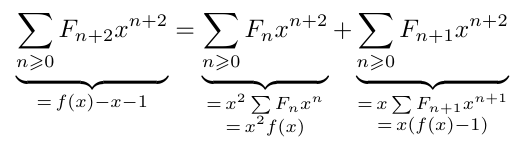
so we see that 


Let’s actually see this function f(x) as the generating function of some species. Starting with the second recursive definition from above, let’s expand it, but we’re going to write it in a funny way:


Because we wrote it this funny way, we can see that each term is like a list of all the ways one could write a number as the sum of a sequence of 1’s and 2’s. So it describes a partition of an n-element totally ordered set into ordered blocks of size either 1 or 2.
Exercises:
1) Show that 


2) Expand 


3) Show that 

Next time, we’ll continue with our analysis of the Fibonacci numbers using species.
 Joe Moeller
2 thoughts on “Combinatorics, Lecture 4 (8 Oct 2019)”