Thanks to Tim Hosgood for helping me type these notes up.
Previous lecture here.
Fibonacci and `tribonacci’ numbers
Recall: there’s a species 
G(X) = {ways to totally order X and chop it into blocks of length 1 or 2}
For example,

We saw that

where 


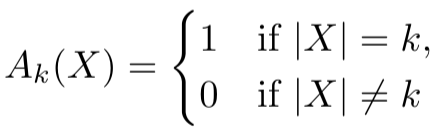
but this gives that 
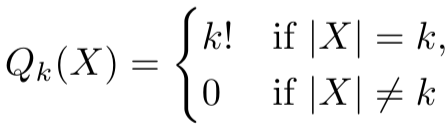
so that 
To totally order X and chop it into blocks of length 1 or 2, you just
- see if
, and stop if so; otherwise
- chop X into two subsets: the first with 1 element, and the second totally ordered and chopped into blocks of length 1 or 2; or
- chop X into two subsets: the first with 2 elements, and the second totally ordered and chopped into blocks of length 1 or 2.
Note that 


Going yet one more level, we get the tribonacci numbers, which are those that follow


i.e. 1, 1, 1, 3, 5, 9, 17, 31, …
Indeed, there’s a species 


Trees
Let 
B(X) = {binary rooted planar trees with leaves equipped with a bijection to X}
as in Lecture 3. Notice that
|B(n)|= n! |{binary rooted planar trees}|
since a B-structure on X is a total ordering along with a choice of binary rooted planar tree. For example, |B(5)| = 5! 5.
Here, 


but since |B(0)| should be 0, not 1, we see that we want to take the root given by taking 


and so


…


where we are using !! to denote the double factorial. More interesting is the fact that


Next time, we’ll return to the Catalan numbers.
 Joe Moeller