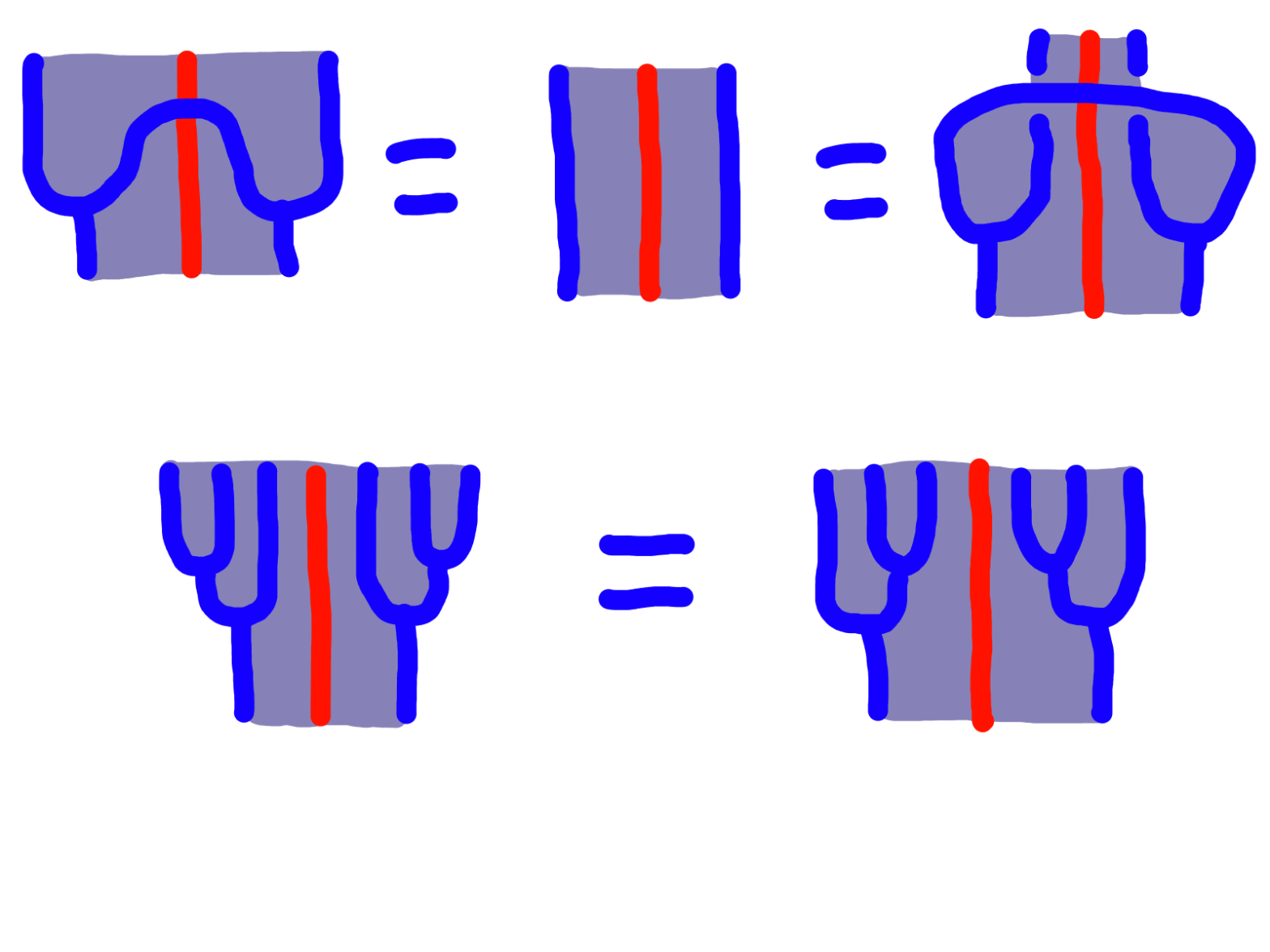
My intention with this blog post is not to teach what a monad is, and it’s not to teach how string diagrams work. I just want to share some strings I drew to represent monoidal monads. This post is the first part of a series of posts where I present a diagrammatic language I usedContinueContinue reading “A different string presentation of monads”
Author Archives: Joe Moeller
Combinatorics, Lecture 5 (10 October 2019)
Thanks to Tim Hosgood for helping me type these notes up. Previous lecture here. Fibonacci and `tribonacci’ numbers Recall: there’s a species $latex G \colon \mathsf S \to \mathsf F$ with G(X) = {ways to totally order X and chop it into blocks of length 1 or 2} For example, We saw that $latex |G|(X)ContinueContinue reading “Combinatorics, Lecture 5 (10 October 2019)”
Combinatorics, Lecture 4 (8 Oct 2019)
Lecture 3 here. Using Generating Functions We defined two binary operations on species $latex \mathsf{S} \to \mathsf{Set}$: Addition. $latex (G+H)(X)=G(X)+H(X)$; Multiplication. $latex (GH)(X) = \{(Y,g,h) \mid Y \subseteq X, g \in G(Y), h \in H (X \setminus Y)\}$. These obey $latex |G+H| = |G|+|H|$ and $latex |GH|=|G||H|$. In total, we’ll talk about five binary operationsContinueContinue reading “Combinatorics, Lecture 4 (8 Oct 2019)”
Combinatorics, Lecture 3 (3 Oct 2019)
Lecture 2 here. Thanks again to Tim Hosgood for the beautiful pictures. The category of species Last time, we looked at the relationship between species and their generating functions, a formal power series associated to a species which lets you count structures described by the species. Now we’ll take a closer look at species themselves.ContinueContinue reading “Combinatorics, Lecture 3 (3 Oct 2019)”
Combinatorics, Lecture 2 (1 Oct 2019)
In Lecture 1, we gave the idea of what a species is and saw a few examples. Now we’ll explore the idea more and see more examples. We’ll also talk about the connection to generating functions, and some operations that let us build new species from old. Thanks to Tim Hosgood for helping me outContinueContinue reading “Combinatorics, Lecture 2 (1 Oct 2019)”
Combinatorics, Lecture 1 (26 Sep 2019)

John Baez is teaching a course on combinatorics this quarter. I’m taking detailed notes and texing them up. I’m also going to start blogging them. Credit to Tim Hosgood for the pictures. Prehistory of the course Larry Harper taught this course in the past. John is going to be talking about combinatorial species. He previouslyContinueContinue reading “Combinatorics, Lecture 1 (26 Sep 2019)”
How I got into my research
Due to some conversations that were happening on Twitter, I feel compelled to tell the story of how I got into my research and the role that my advisor played. Note that I went to UC Riverside for my B.S., which is also where I’m doing my PhD now. Choosing an advisor In undergrad, IContinueContinue reading “How I got into my research”
What is the Grothendieck construction like?
This is my best attempt at an intuitive introduction to the Grothendieck construction. I’ll give you the definition, but not before warming up to the idea. I’ll start with the earliest conceptual ancestor I could come up with: addition. Numbers, Addition What am I going to tell you about addition that you don’t already know?ContinueContinue reading “What is the Grothendieck construction like?”
Reference List: Operads and Combinatorial Species
(1972) The Geometry of Iterated Loop Spaces – May [pdf](1973) Homotopy Invariant Algebraic Structures on Topological Spaces – Boardman, Vogt(1981) Une théorie combinatoire des séries formelles – Joyal [link](1989) The Relation between Burnside Rings and Combinatorial Species – Labelle, Yeh [link](1990) Generatingfunctionology – Wilf [link](1997) Combinatorial Species and Tree-like Structures – Bergeron, Leroux, Labelle [firstContinueContinue reading “Reference List: Operads and Combinatorial Species”
Algebraic Analysis notes Lecture 11 (4 Feb 2019)
Notes for lecture 10 Last time: for an abelian category A, C(A) is the category of complexes in A. Say $latex f, g \in \mathrm{Hom}_{C(A)} (X, Y)$ are homotopic, f~g, if there are maps $latex s^i : X^i \to Y^i$ such that $latex f^i -g^i = d_Y s + sd_X$. Definition The homotopy category K(A)ContinueContinue reading “Algebraic Analysis notes Lecture 11 (4 Feb 2019)”
 Joe Moeller