Algebraic Analysis notes Lecture 8 (28 Jan 2019)

Notes for lecture 7

Last time: we defined additive categories, and kernels for morphisms in additive categories.

Definition: The cokernel of a morphism \phi (if it exists) is the universal object cok \phi with the dual universal property:

Definition: an additive category C is abelian if
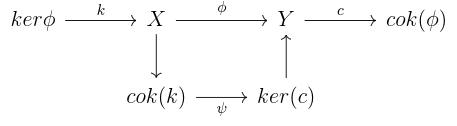
(A4) for any \phi \colon X \to Y, the kernel and cokernel exist, and the natural map \psi:

is an isomorphism.

Remark: A4 implies that if \phi has ker \phi = 0 and cok \phi = 0, then \phi is an isomorphism.

Examples:

  • Ab, or more generally k-mod, is additive, and A4 holds because cok(k) = X / ker\phi \cong im \phi = ker(c) by the first isomorphism theorem
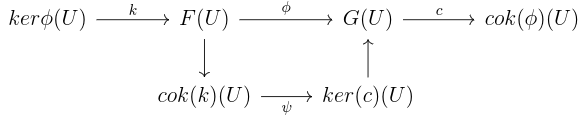
  • PreSh(X;k) is abelian, as we saw last time, given \phi \colon F \to G, then ker\phi is given by ker \phi (U) = ker (\phi(U) \colon F(U) \to G(U)), and ker \phi is a presheaf which is the kernel of \phi. Let cok^{pre}(\phi)(U) = cok(\phi(U) \colon F(U) \to G(U)), and by similar reasoning, this is the cokernel in PreSh(X;k). Then for U open in X, reduces to the case in k-mod. Thus PreSh(X;k)
Sheaves need a little more work. If \phi \colon F \to G is a map of sheaves, cok^{pre}(\phi) might not be a sheaf.

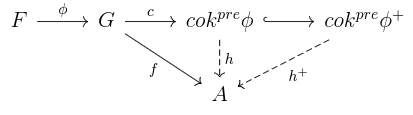
Proposition: In Sh(X;k), the cokernel of \phi \colon F \to G is given by cok\phi = cok^{pre}\phi^+, and on stalks (cok \phi)_x = cok(\phi_x \colon F_x \to G_x).

proof: Recall that a map of sheaves is just a map of presheaves that happens to go between sheaves. Given a sheaf A, and a morphism f \colon G \to A such that f \circ \phi = 0, universal property of cok^{pre}(\phi) in PreSh(X;k) gives a map h \colon cok^{pre}(\phi) \to A. Then universal property of sheafification says that the map h \colon cok^{pre}(\phi) \to A induces a map h^+ \colon cok^{pre}(\phi)^+ \to A.

Jade Master, sitting next to me in class, pointed out that you can just invoke “left adjoints preserve colimits”.

Direct limits in k-mod are exact. So they commute with kernels and cokernels, giving (ker \phi)_x = ker (\phi_x) and (cok \phi)_x = cok (\phi_x) (sheafification preserves stalks).

Lemma: Let \phi \colon F \to G be a map of sheaves. The following are equivalent:

  1. \phi is an isomorphism
  2. for any U open in X, \phi(U) \colon F(U) \to G(U) is an isomorphism
  3. for any point x in X, \phi_k \colon F_x \to G_x is an isomorphism

proof: (1 <=> 2) is obvious. (3 => 2) is obvious. Suppose \phi_x is an isomorphism for every point x in X. We want to show that \phi_U is an isomorphism for each U open in X. Fix U open in X. Let s \in F(U). If \phi_U(s) = 0, then \phi_U (s)_x = 0 = \phi_x (s_x), so s_x = 0 for each x, so s=0, so \phi_u is injective.

Let t \in G(U). For each point x in X, consider \phi^{-1}_x (t_x) \in F_x. Let U^x be an open neighborhood of x, and s^x \in F(U^x) such that s^x_x = \phi^{-1}_x (t_x). Then (\phi_{U^x} (s^x))_x = t_x, so there is a V^x \subset U^x such that \phi_{U^x} (s^x) |_{V^x} = t |_{V^x}.

claim: s^x |_{V^x \cap V^y} = s^y |_{V^x \cap V^y}. We want this so that the s^x glue to give s \in F(U). Recall that we showed \phi_U is injective for all U open in X, and note

\phi_{V^x \cap V^y} (s |_{V^x \cap V^y}) = \phi_{V^x} (s^x) |_{V^x \cap V^y}
= t |_{V^x \cap V^y} = \phi_{U^y} (s^y) |_{V^x \cap V^y}
= \phi_{V^x \cap V^y} (s^y |_{V^x \cap V^y})

Thus there is an s \in F(U) such that s|_{U^x} = s^x and \phi_U(s) |_{U^x} = \phi_{U^x} (s^x) = t|_{U^x}. Then by uniqueness of sections, \phi_U(s) = t, so \phi_U is surjective, completing the proof.

Theorem: Sh(X;k) is abelian.

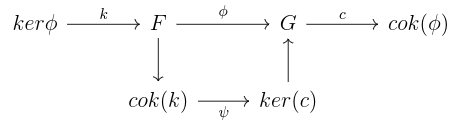
Let \phi \colon F \to G be a map of sheaves.

We need to show that \psi is an isomorphism. It suffices to check on stalks. But (ker(f))_x = ker(f_x) and (cok(f))_x = cok(f_x), so it reduces to k-mod.

Notes for Lecture 9

Published by Joe Moeller

Mathematician

3 thoughts on “Algebraic Analysis notes Lecture 8 (28 Jan 2019)

Leave a comment