Notes for lecture 8
Last time we showed that Sh(X;k) is an abelian category. So we’ll get:
- a notion of simple objects
- complexes, exactness, cohomology of complexes
- 5-lemma
- snake lemma
- Jordan-Holder theorem for abelian categories of finite length
For  , we saw
  and
and  .
.
Corollary: A sequence  in Sh(X;k) is exact iff
  is exact for any point x in X.
In particular, we can check if  is injective/surjective by checking if
  is injective/surjective for all points x in X.
Lemma: is injective iff  is injective.
Surjectivity is more complicated!
Lemma:  is surjective iff for any U open in X and
  , there is an open cover
  of U such that for any
  ,
,  is in the image of
  .
.
In particular, if  is surjective for any U open in X, then is surjective, but the converse is not necessarily true.
Lemma: A sequence of sheaves  is exact iff
  is exact.
proof: If is exact, then  is injective. If
  failed to be exact for some open U in X, then
  would be an isomorphism. Then
  would not be an isomorphism. Contradiction.
Functors between abelian categories
Definition: If A and B are additive categories, and  is a functor, we say F is additive if for any objects x,y in A, the map
  is a group homomorphism.
Definition: If A and B are abelian categories, we say F is exact if for any short exact sequence  in A, then
  is exact in B. F is called left exact if
  exact implies
  exact. F is called right exact if
  exact implies
  exact.
Exact functors can be computed inductively. But to compute left/right exact functors, we need homological algebra.
Example/Exercise: Let C be an abelian category, and Y and object in C. We get two functors:  and
and  . These are both left exact.
When  is exact, then we say that Y is projective, and if
  is exact, we say that Y is injective.
Definition: Let  . Then module of global sections of F, denoted
  , is the k-module
  . The module of global sections with compact support,
  , is the k-module
  .
.
Proposition: The functors  and
and  are both left exact.
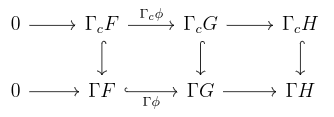
proof:  is left exact by the previous lemma. Consider
  exact.
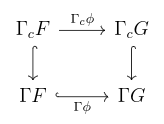
Since this diagram commutes:
then  is injective. If
  is in the kernel of
  , then there is a
  such that
  . Then for any point x in X,
  , but each is injective. Then supp(t) = supp(s), which is compact, so t is compactly supported,
  .
.
Let  be a continuous map of topological spaces. Consider the induced map
  given by
  . Check that this is indeed a sheaf on Y. Also, given a map of sheaves on X , For any U open in Y, induces a map
  , and
, and  is a functor.
Examples:
- Let Y={o}, and
 . Then
  (this is the simplest example of sheaf pushforward)
 - if
 is a closed embedding, then
  , called the “extension of F by zero”
Notes for lecture 10


2 thoughts on “Algebraic Analysis notes Lecture 9 (30 Jan 2019)”