Last time: 
Poincare Lemma: Let M be a manifold. Consider the following complex of sheaves:

where d is the de Rham differential, and 


Then apply 

This is a chain complex of real vector spaces. The cohomology of this complex is the de Rham cohomology:
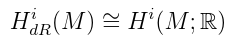
This construction is analogous to the definition/construction of Ext groups! Let X be a k-module, and given another k-module Y take a projective resolution of Y:

Apply Hom(X, -) to this resolution to get a complex

Then let 
Exercise: The k-module 


Category of Complexes
Definition: A complex in an abelian category is a sequence

such that 

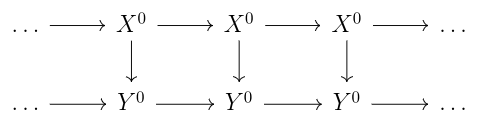
Let C(A) be the category of complexes in A. Note the kernel and cokernel are given by 


Definition: If 
![X^\bullet [n]](https://s0.wp.com/latex.php?latex=X%5E%5Cbullet+%5Bn%5D&bg=060f29&fg=f2f2f2&s=0&c=20201002)
![X[n]^i = X^{i+n}](https://s0.wp.com/latex.php?latex=X%5Bn%5D%5Ei+%3D+X%5E%7Bi%2Bn%7D&bg=060f29&fg=f2f2f2&s=0&c=20201002)
![d_{X[n]}^i = (-1)^n d^{i+n}_X](https://s0.wp.com/latex.php?latex=d_%7BX%5Bn%5D%7D%5Ei+%3D+%28-1%29%5En+d%5E%7Bi%2Bn%7D_X&bg=060f29&fg=f2f2f2&s=0&c=20201002)
Why the sign? We want things to be “graded-commutative”, i.e. if s, t are homogeneous operators, then 

![f[n]^i = f^{i+n}](https://s0.wp.com/latex.php?latex=f%5Bn%5D%5Ei+%3D+f%5E%7Bi%2Bn%7D&bg=060f29&fg=f2f2f2&s=0&c=20201002)
Note for abelian category A that 

Definition: A homomorphism f of complexes is a quasi-isomorphism if the map f induces on cohomology 
Definition: A complex is acyclic if it is quasi-isomorphic to 0, i.e. 
Definition: The mapping cone of 

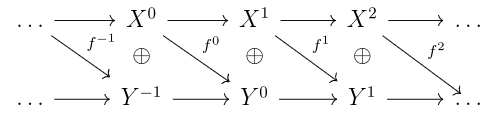
Check that this is a complex.
Exercises:
- C(f) is functorial.
- there is a short exact sequence
- Let K = ker(f), Q = cok(f). Then
![0 \to B^\bullet \xrightarrow{i} C(f) \xrightarrow{p} A[1] \to 0](https://s0.wp.com/latex.php?latex=0+%5Cto+B%5E%5Cbullet+%5Cxrightarrow%7Bi%7D+C%28f%29+%5Cxrightarrow%7Bp%7D+A%5B1%5D+%5Cto+0&bg=060f29&fg=f2f2f2&s=0&c=20201002)
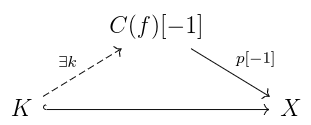
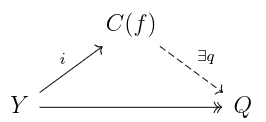
- If f is injective (resp. surjective) then
(resp.
) is a quasi-isomorphism.
- If f is an isomorphism, then C(f) is acyclic.
- For any i, the short exact sequence above induces exact

Definition: A map 

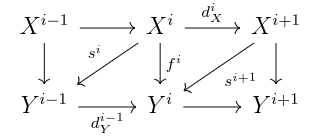
We say f and g are homotopic, and write f~g, if f-g is null-homotopic.
Note if f~0, then 

Definition: The homotopy category K(A) of an abelian category A is the category with complexes of A for objects, and homotopy classes of complex homomorphisms for morphisms 
 Joe Moeller
2 thoughts on “Algebraic Analysis notes Lecture 10 (1 Feb 2019)”