Last time: for an abelian category A, C(A) is the category of complexes in A. Say 


Definition The homotopy category K(A) of A is the category with objects complexes of A, and morphisms are homotopy classes of morphisms of complexes. The motivation for this is from algebraic topology, where there is a homotopy category of topological spaces, hTop, where the objects are topological spaces and the morphisms are homotopy classes of continuous maps.
Example Singular cochains gives a functor 
Let 


We also defined the mapping cone 

Proposition/Exercise For a map of complexes
- f~0
- f factors through the canonical map
- f factors through the canonical map
- the sequence
splits

![p [-1] : C(1_Y) [-1] \to Y](https://s0.wp.com/latex.php?latex=p+%5B-1%5D+%3A+C%281_Y%29+%5B-1%5D+%5Cto+Y&bg=060f29&fg=f2f2f2&s=0&c=20201002)
Corollary If 


proof If f~0, then f factors through 
Corollary Every homotopy equivalence (i.e. isomorphism in K(A)) is a quasi-isomorphism.
Note that K(A) (nor the derived category D(A), as we will see) is an abelian category! It is a triangulated category.
Lemma Given

The composite of any two consecutive maps is zero in K(A).
proof The composite of ![Y \to C(f) \to X[1]](https://s0.wp.com/latex.php?latex=Y+%5Cto+C%28f%29+%5Cto+X%5B1%5D&bg=060f29&fg=f2f2f2&s=0&c=20201002)

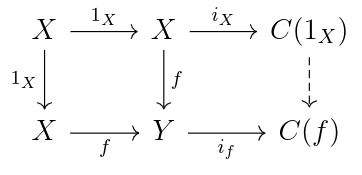
So 


![C(f) \to A[1] \to B[1]](https://s0.wp.com/latex.php?latex=C%28f%29+%5Cto+A%5B1%5D+%5Cto+B%5B1%5D&bg=060f29&fg=f2f2f2&s=0&c=20201002)
Definition A triangle in an additive category with a shift funcor [1] is a sequence ![A \xrightarrow{f} B \xrightarrow{g} C \xrightarrow{h} A[1] \to \dots](https://s0.wp.com/latex.php?latex=A+%5Cxrightarrow%7Bf%7D+B+%5Cxrightarrow%7Bg%7D+C+%5Cxrightarrow%7Bh%7D+A%5B1%5D+%5Cto+%5Cdots&bg=060f29&fg=f2f2f2&s=0&c=20201002)
So ![X \to Y \to C(f) \to A[1]](https://s0.wp.com/latex.php?latex=X+%5Cto+Y+%5Cto+C%28f%29+%5Cto+A%5B1%5D&bg=060f29&fg=f2f2f2&s=0&c=20201002)
A morphism of triangles is a commutative diagram:
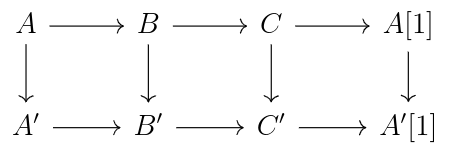
In K(A), a standard triangle is one of the form ![X \xrightarrow{f} Y \to C(f) \to X[1]](https://s0.wp.com/latex.php?latex=X+%5Cxrightarrow%7Bf%7D+Y+%5Cto+C%28f%29+%5Cto+X%5B1%5D&bg=060f29&fg=f2f2f2&s=0&c=20201002)
Proposition Exact triangles satisfy:
- for any map
there is an exact triangle
and
is an exact triangle
- If
and
- Direct sum of exact triangles is exact
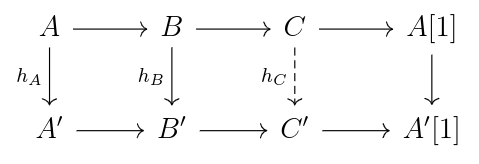
- Given two exact triangles
, and
, and morphisms
and
such that the square commutes, then there exists a map
making this collection of maps a map of triangles
![Z[-1] \to X \to Y \to Z](https://s0.wp.com/latex.php?latex=Z%5B-1%5D+%5Cto+X+%5Cto+Y+%5Cto+Z&bg=060f29&fg=f2f2f2&s=0&c=20201002)
 Joe Moeller
What’s D(A)? I forget.
LikeLike
Its the derived category. It hasn’t come up yet in these notes, so I’ve edited it to reflect that. Thanks.
LikeLike